Apoha is building the third fundamental data class of molecular science

First, Sequences told us what a molecule is.
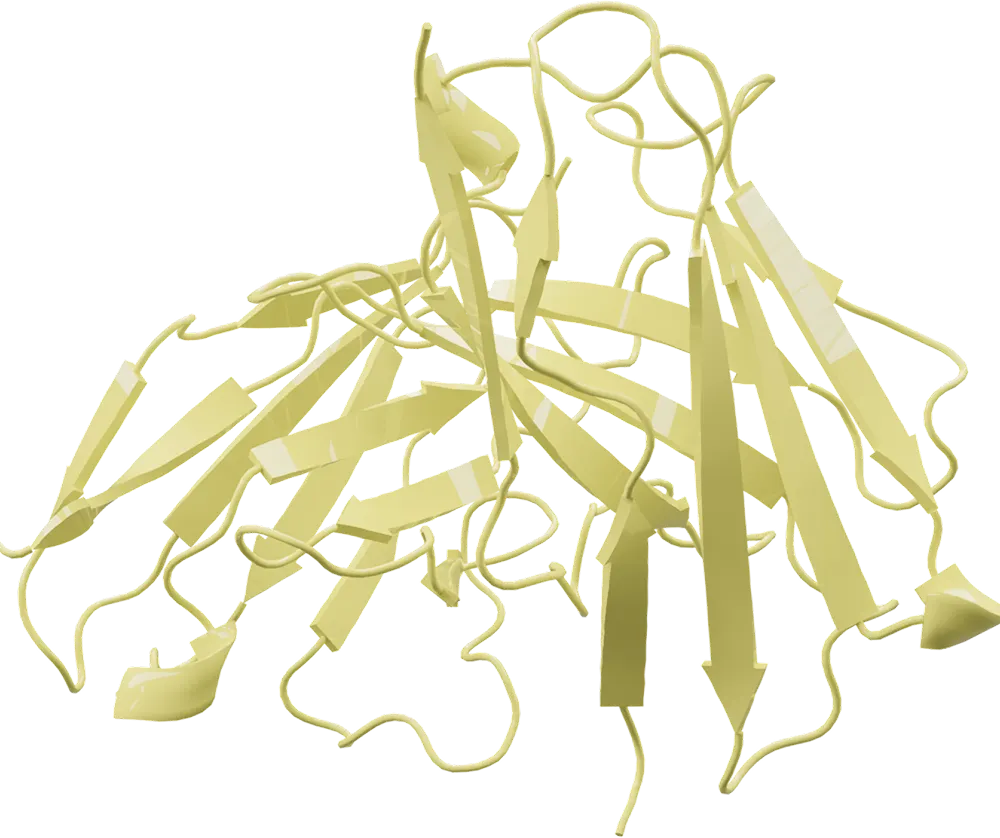
Then, Structures showed us what a molecule looks like.
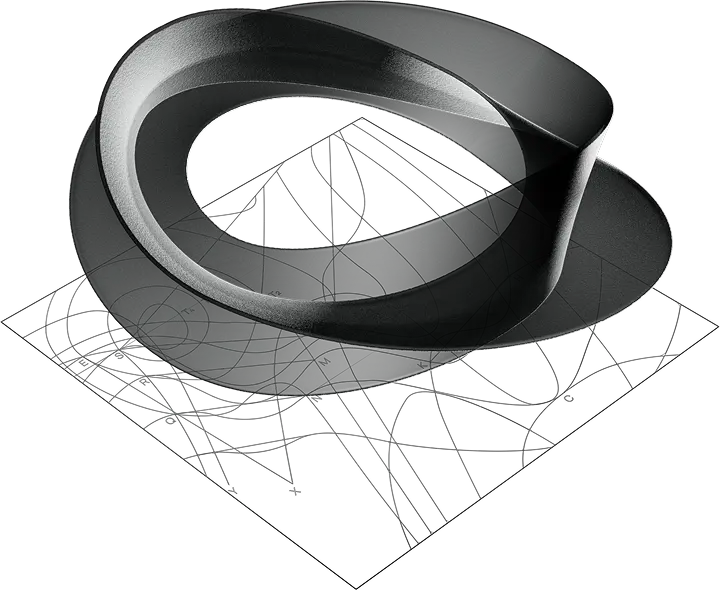
States tells us how it behaves.
Behaviour is what decides real-world outcomes, whether a drug survives development, whether a formulation holds together.
It is the layer for which molecular science has never had a data class.
We call this new paradigm:
Liquid State Intelligence
.webp)
The measurement principle
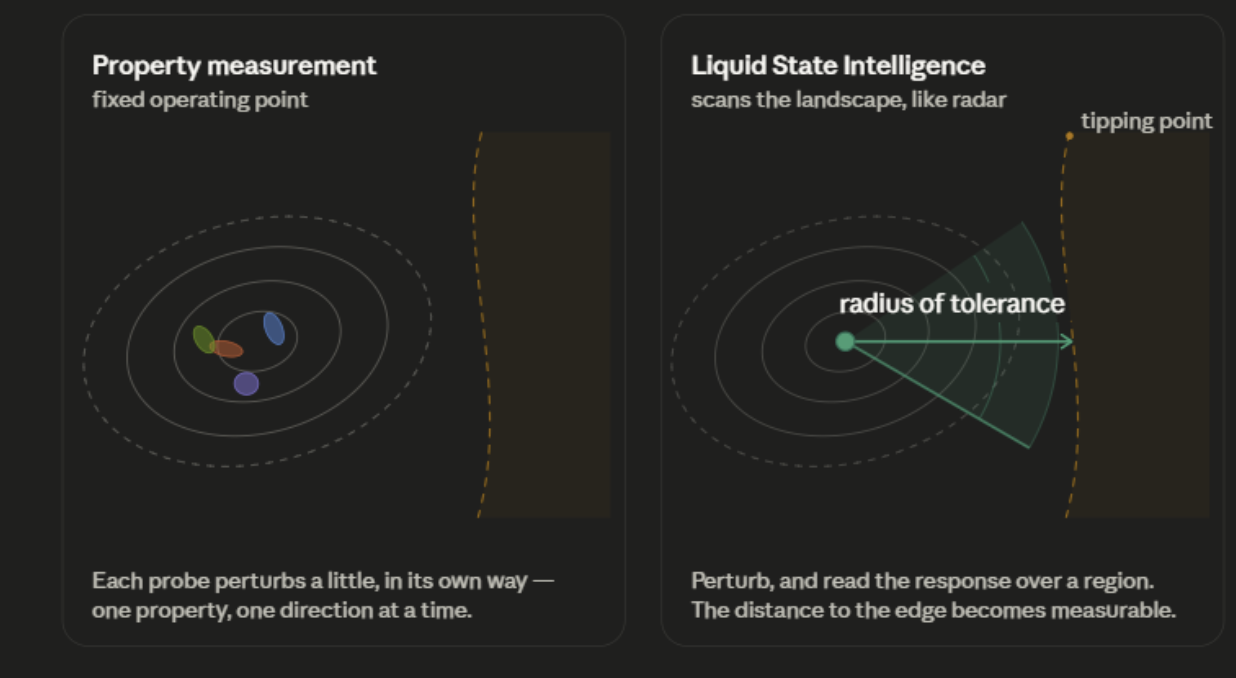
Behaviour (folding, binding, aggregation, gelation, degradation, etc) is how a formulation moves through thermodynamic state space. It emerges when a system is pushed, not when it sits at rest. So we measure it the way the contact senses do: perturb the sample and read the response as it unfolds, coupled across mechanical, chemical, electrical and thermal channels, far from equilibrium, where differences are largest and most revealing. This approach is broadly grounded in the relaxation spectra class of methods in physical chemistry.
We read that response at a liquid interface held near a thermodynamic transition. Near a transition, a system's susceptibility increases nonlinearly, so small differences between samples produce outsized, distinguishable responses. The interface becomes an amplifier of state rather than a passive container.
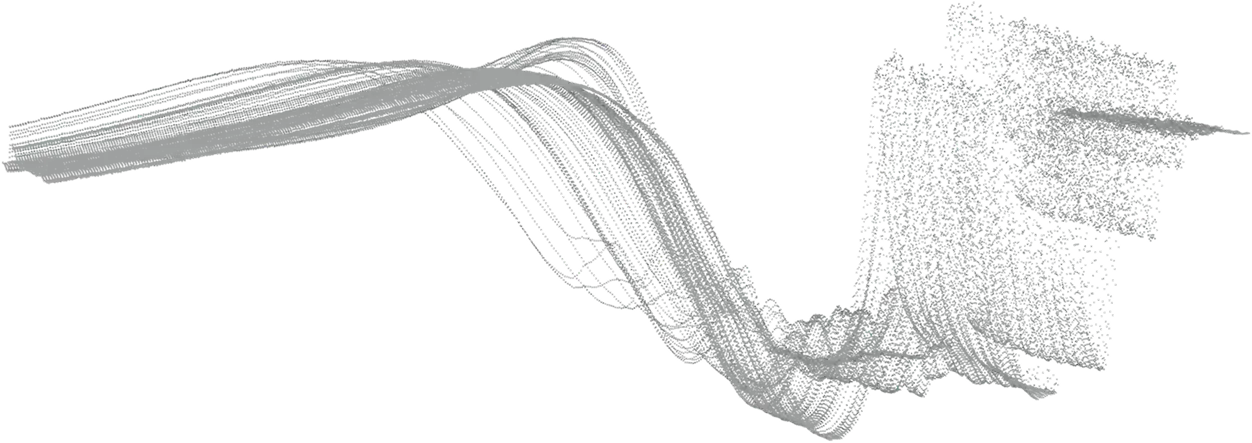
And the interface does more than register the perturbation — it propagates it. Our foundational work on nonlinear interfacial waves established that how such a response travels depends on the thermodynamic state it travels through. The emission is therefore not a side effect of the measurement; it is a carrier of state, radiating outward to be decoded. We learn that decoding from data and hold it to benchmarked molecules — which is where the precision figures come from.
How the technology works
In practice, a small, precise volume of the sample is deposited onto a prepared liquid interface. The contact perturbs the interface, and the emissions that radiate from it — captured in real time through a specialised imaging system — form a time-resolved signature of how the sample responds under stress. The readout is label-free, needs as little as 10µg of material, and runs at screening throughput.
We call a single measurement a VIBE check — Variations in Interfacial Behaviour under Excitation. Each one returns not a single number but a high-dimensional behavioural signature: a representation of how a sample behaves, rather than what it is made of or what it looks like. In particular, it provides a clear flag if there are nearby tipping points or phase transitions in the thermodynamic landscape of the molecule, which can signal whether a molecule is destined to eventually fail.
Prediction with scale
Behavioural signatures become powerful at scale. Plotted together, they form a space where distance has meaning: samples that sit close behave similarly, even when their sequences, structures or compositions are very different. That lets you ask a different question — not "what is compositionally similar?" but "what behaves similarly?" — and it lets models learn the relationship between molecular identity and behaviour.
Given a new candidate, those models can estimate where it will sit before it is fully characterised: flagging liabilities earlier, narrowing a field faster, and replacing months of empirical iteration with a measurement that costs micrograms.

Benchmarks
We have applied this to solve hard problems across materials from soil to serums, including identifying a plant protein that behaves like a chicken protein in a product now on shelves. The sharpest test is antibodies. Working with Boehringer Ingelheim, and in a study later presented at PEGS, unstable candidates were shown to undergo a visible gelation in the neck between merging liquids — detectable from tens of micrograms in dilute solution. On that basis, behavioural embeddings identify failure-prone molecules with greater than 90% precision, in an explainable way, at the discovery stage where material is scarce and decisions are still cheap.